| Garantie LCD/Backlight (Jahre): | 3/3 incl. Vor-Ort-Austauschservice |
| max. Pixelfehler (nach ISO 13406-2): | Klasse II |
| Panelgröße: | 20,1″ |
| Pixelgröße [mm]: | 0.255 |
| Standardauflösung: | 1.600 x 1.200 |
| Sichtbare Bildgröße/-diagonale [mm]: | 408 x 306 / 510 |
| Videoeingang, Stecker: | 2 x DVI-I analog & digital |
| Bildfrequenz [Hz]: | 48 – 85 |
| max. Zeilenfrequenz / Videobandbreite [kHz/MHz]: | 30 – 94 / – |
| Farbmodi Preset/User: | 3 / 1 |
| LCD drehbar/Portrait Modus: | Ja / Ja |
| LCD Display Arm Option: | Ja |
| Ausstattung: | 2 x DVI-D Kabel (digital), 2 x DVI-A Kabel (analog), USB-Kabel, internes Netzteil, Netzkabel |
| Monitormaße (B x H x T) [mm]: | 443 x 425 – 555 x 220 (Panel im Querformat) |
| Gewicht [kg]: | 9,2 |
| Prüfzeichen: | TCO 03 (Emissionen, Ergonomie, Umwelt), ACA-Zertifizierung (Australien), kanadische Anforderungen/CSA, CE-Zeichen, CCIB/CCEE-Zertifizierung (China), CISPR-Anforderungen, osteuropäische Zertifizierungen, Energy Star, FCC-Zertifizierung, Ergonomie (Deutschland, TÜV und GS-Zeichen), ISO 9241-3,7,8 VDT-Richtlinien, ISO 13406-2 Richtlinien für defekte Pixel, NOM-Zertifizierung (Mexiko), MIC-Anforderungen (Neuseeland), MPR-II, skandinavische Zertifizierungen (Nemko, Fimko, Demko, Semko), PC2001, PC99-Zertifizierung, MIC-Zertifizierung (Südkorea), BSMI-Zertifizierung (Taiwan), TÜV-Ergo, UL-Auflistung, VCCI-Zertifizierungen, Windows® Zertifizierung (Microsoft® Windows® 98, Microsoft® Windows® 2000 und Microsoft® Windows® XP) |
| Leistungsaufnahme On/Stand-by/Off [Watt]: | 48,8 / 0,9 / 0,4 |
Einleitung
Die „Business Performance Line“ von Hewlett-Packard richtet sich an professionelle Anwender oder Anwender mit gehobenen Ansprüchen. Hierzu gehört auch der HP LP2065, der mit ansprechendem Design und umfangreicher Ausstattung überzeugen soll. Wie überzeugend das Gerät in der täglichen Praxis, beim Arbeiten, Spielen und der DVD-Wiedergabe ist, erfahren Sie im nachfolgenden Testbericht.
Alle in diesem Test veröffentlichten Ergebnisse wurden am digitalen Eingang ermittelt. Lediglich die analoge Bildqualität wurde am analogen Anschluss getestet. Alle Tests wurden an einer Gainward PowerPack! Ultra/2600 Golden Sample Grafikkarte und zwei Point of View GeForce 7800GTX 512MB (SLI) Grafikkarten durchgeführt.
Lieferumfang
Im Lieferumfang des HP LP2065 ist folgendes enthalten: Ein Handbuch mit ersten Installationshinweisen, zwei DVI-D Kabel (digital), zwei DVI-A Kabel (analog), USB-Kabel, Netzkabel und eine CD, die den Windows INF-Monitortreiber, ein ausführliches Handbuch im PDF-Format, die Programme Adobe Reader, Pivot Pro und HP Display LiteServer enthält sowie auch die Test- und Einstellsoftware HP Adjustment Pattern.
Die Installationsanleitung und das ausführliche PDF-Handbuch liegen in mehreren Sprachen vor. Ein ausführliches Handbuch in gedruckter Form liegt dem TFT nicht bei. Das stellt heute leider eine übliche Praxis dar. Der Lieferumfang des HP LP2065 ist insgesamt umfangreich und kann bezüglich der mitgelieferten Monitorkabel als vorbildlich bezeichnet werden.

Optik und Mechanik
Das Gehäuse des HP LP2065 ist in den Farben schwarz und silber gehalten; der Monitor macht optisch einen ansprechenden Eindruck.


Das Panel ist von einem schmalen, silbernen Rahmen umgeben, der links und rechts 1,6 cm, oben 1,7 cm und unten 1,9 cm schmal ist. Mittig am unteren Rand des Rahmens sind vier Bedientasten platziert und weiter rechts davon befindet sich der Powerschalter.

Der HP LP2065 ist drehbar, neigbar, um 13 cm in der Höhe verstellbar und verfügt über eine Pivotfunktion. Damit lässt der TFT in Sachen Ergonomie keinen Wunsch offen. In der niedrigsten Höheneinstellung beträgt der Abstand von der Gehäuseunterkante bis zur Tischoberfläche 9,5 cm.


Die Pivotfunktion besitzt in der Landscape- und Portraitstellung jeweils einen Einrastpunkt. Da dieser etwas Spiel hat, muss der Monitor per Hand gerade ausgerichtet werden.


Die Neigung des Gehäuses kann von –5 Grad nach vorne bis +30 Grad nach hinten eingestellt werden. Der TFT lässt sich auch um 45 Grad nach links und rechts schwenken. Der Fuß behält dabei seine Position auf dem Tisch bei, denn das Drehgelenk befindet sich oben am Arm des Standfußes.


Eine Kabelführung ist an beiden Seiten des Fußes vorhanden. Die Kabelkanäle sind hinter einer flexiblen, gummiartigen Abdeckung verborgen. Praktisch: Wenn man die Abdeckung zur Seite drückt, können die Kabel ganz einfach in die Führung eingefädelt werden.

funktioniert einwandfrei; alle Gelenke sind weder zu schwer- noch zu leichtgängig. Hewlett Packard hat hier sehr gute Arbeit geleistet.


Der Monitor verfügt über zwei VESA100 Montagemöglichkeiten. Um diese nutzen zu können, muss zuerst der Fuß des LP2065 vom Gehäuse abgenommen werden. Das ist sehr einfach, da hierfür lediglich ein Hebel am Standfuß umgelegt werden muss. Das Display kann dann ganz einfach nach oben vom Fuß abgehoben werden.

Ist das Gehäuse vom Standfuß getrennt, gibt es zwei Möglichkeiten der Montage einer VESA100-Halterung. Erstens: die Halteplatte vom Gehäuse abschrauben und die VESA-Halterung an deren Stelle direkt am Gehäuse anbringen und zweitens: die Arretierungsplatte vom Fuß des HP LP2065 abschrauben und an der VESA100-Halterung montieren.
Die zweite Lösung halten wir für die bessere, denn so lässt sich der TFT auf Wunsch – wie beim Originalfuß – ganz einfach von der Halterung abnehmen.


Der HP LP2065 hat mit Standfuß ein Gewicht von 9,2 Kilogramm, wobei der Fuß alleine schon 3,45 Kilogramm auf die Waage bringt. Der Fuß besitzt eine innere tragende Struktur aus Metall, die von einer schwarzen Kunststoffschale eingefasst wird.

Der schwere, große Standfuß des HP LP2065 bietet eine ausgezeichnete Standsicherheit auf dem Tisch. Selbst ein heftiges Anstoßen der Tischplatte bringt das Display kaum aus der Ruhe, ein Umkippen ist praktisch ausgeschlossen.


Die Power-LED befindet sich links neben dem Powerschalter. Im Betrieb leuchtet die LED grün, im Stand-by-Mode orange. Die Helligkeit der LED ist zwar recht hoch, aber für unser Empfinden noch nicht störend.


Der HP LP2065 ist im Betrieb praktisch geräuschlos; ein sehr leises Brummen ist nur dann hörbar, wenn man direkt an der Gehäuserückseite horcht.
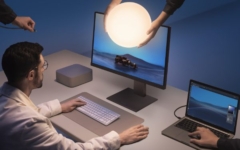


Das integrierte Netzteil des TFTs verfügt auf der Rückseite über einen Ein-/Ausschalter. Damit kann der LP2065 vom Stromnetz getrennt werden, ohne das Netzkabel herauszuziehen. Sitzt man vor dem Monitor, ist der Netzschalter allerdings nur mit Verrenkungen erreichbar.
Die Leistungsaufnahme des HP LP2065 liegt laut Hewlett-Packard bei maximal 75 Watt, wenn alle USB-Anschlüsse belegt sind. Im Stand-by-Mode liege der Verbrauch bei maximal zwei Watt. Wir haben mit einem Energieverbrauchs-Messgerät die angegebenen Werte überprüft.



Stromverbrauch
| Hersteller | Gemessen | |
| Betrieb maximal | 75 W | 48,8 W |
| Stand-by Mode | 2 W | 0,9 W |
| Ausgeschaltet | – | 0,4 W |
Die Leistungsaufnahme des HP LP2065 liegt deutlich unter den Herstellerangaben und ist für einen 20 Zoll TFT auch nicht zu hoch. Trennt man das Gerät per Netzschalter vom Stromnetz, liegt der Verbrauch bei null Watt. Betätigt man nur den Powerknopf zum Ausschalten, so werden noch 0,4 Watt verbraucht.
Die Verarbeitungsqualität des HP LP2065 ist tadellos, alle Gehäuseteile passen sauber zusammen und die Spaltmaße sind gering. Ein Knarren oder Knacken des Gehäuses konnten wir während des Testzeitraums nicht feststellen. Die Mechanik des Testgeräts funktioniert rundum einwandfrei. In der Kategorie „Gehäuseverarbeitung, Mechanik“ erhält der HP LP 2065 damit ein klares „sehr gut“.